
CHRYSLER
1. Brand Overview & Positioning
Chrysler is an American premium automotive brand currently owned by Stellantis (a multinational conglomerate formed by the merger of Fiat Chrysler Automobiles and the French PSA Group).1
Historically one of the “Big Three” American automakers (alongside Ford and General Motors), Chrysler is currently positioning itself as a “Mainstream Premium” brand. It bridges the gap between mass-market vehicles (like Dodge or Chevrolet) and true luxury brands (like Cadillac or Lincoln), focusing heavily on comfort, design, and family utility.
Note: As of late 2024/2025, the brand has a very slim production portfolio, primarily focusing on the minivan segment while it pivots toward an all-electric future.
2. Corporate Evolution: A Timeline of Change
Chrysler has undergone more corporate restructuring than perhaps any other major automaker.
| Era | Corporate Name | Description |
| 1925–1998 | Chrysler Corporation | The independent era. Founded by Walter P. Chrysler. Included brands like Dodge, Plymouth, DeSoto, and Jeep (acquired 1987). |
| 1998–2007 | DaimlerChrysler | A “merger of equals” with German automaker Daimler-Benz (Mercedes). Cultural clashes led to a dissolution. |
| 2007–2009 | Chrysler LLC | Owned by private equity firm Cerberus Capital Management. A difficult period ending in Chapter 11 bankruptcy. |
| 2009–2014 | Chrysler Group LLC | Operated under the management of Fiat during the post-recession recovery. |
| 2014–2021 | FCA (Fiat Chrysler Automobiles) | Fully merged with Fiat. Profitable era driven by Ram and Jeep sales. |
| 2021–Present | Stellantis | Merged with PSA Group (Peugeot, Citroën). Chrysler is now one of 14 brands under this umbrella. |
3. Engineering & Innovation Highlights
Chrysler has historically been known as the “engineering company” of the Big Three.2 They introduced several technologies that changed the industry:
-
Aerodynamics (The Airflow): In the 1930s, the Chrysler Airflow was one of the first cars designed using a wind tunnel.3 It was a commercial flop but an engineering triumph that predicted future car design.
-
The HEMI® Engine: Originally developed for aircraft, the hemispherical combustion chamber engine became legendary in the 1950s (and revived in the 2000s) for producing massive power.
-
The Minivan: Under the leadership of Lee Iacocca in 1983/1984, Chrysler invented the modern minivan (Dodge Caravan/Plymouth Voyager/Chrysler Town & Country). This single-handedly saved the company from financial ruin and created a new vehicle segment.
-
Unibody Construction: Chrysler was an early adopter of unibody frames (where the body and frame are one piece) for mass-market cars, improving rigidity and handling.4
4. Key Vehicles (Past & Present)
The Current Lineup
As the brand transitions, its showroom is currently sparse:
-
Chrysler Pacifica: The flagship of the brand.5 It is a high-end minivan available with a Plug-in Hybrid (PHEV) powertrain. It is widely considered the benchmark for the segment.
-
Chrysler Voyager: An entry-level version of the Pacifica, mainly aimed at fleet sales.6
Iconic Retired Models
-
Chrysler 300: A large, rear-wheel-drive sedan with “gangster” styling that debuted in 2005. It revitalized the brand’s image but ended production in 2023.
-
PT Cruiser: A retro-styled compact car that was incredibly popular in the early 2000s.7
-
Chrysler LeBaron: Synonymous with the 1980s and the “K-Car” platform that made vehicles affordable and efficient.
-
Chrysler Imperial: For decades, this was the top-of-the-line luxury model designed to compete with Cadillac.
5. The Future: Electrification
Chrysler is currently in a “rebuilding” phase. The brand has announced plans to become an all-electric brand by 2028.
-
-
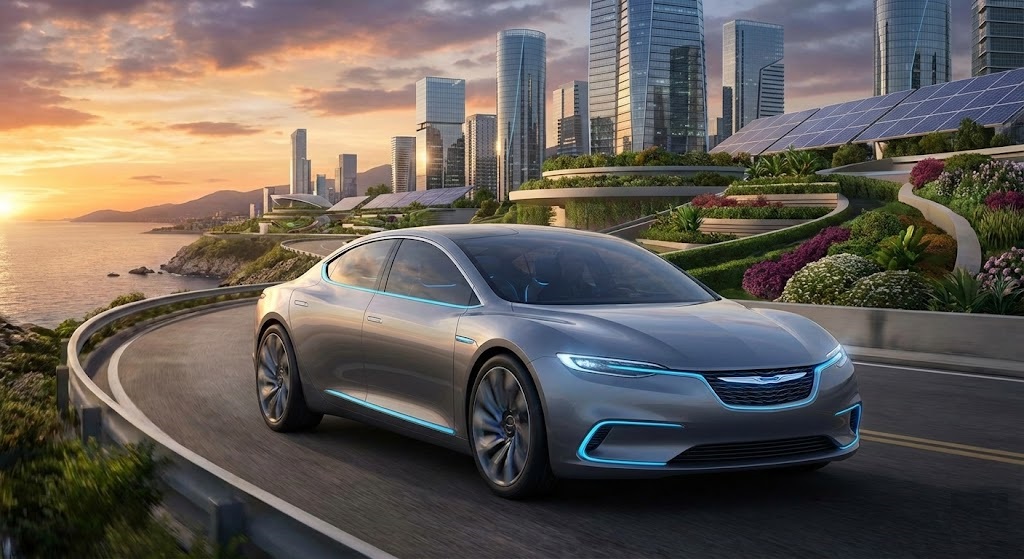
The Halcyon Concept: A futuristic EV concept car unveiled to showcase the brand’s new design language—sleek, low-riding, and packed with autonomous driving technology.8
-
Technological Focus: Future Chryslers will rely on Stellantis’s “STLA Large” electric platform, promising long range and rapid charging.
-